08 December, 2006

No Muslim Burial For Christian


The tussle is over. The Selangor Islamic Religious Council (Mais) has withdrawn its claim to the body of the late Rayappan Anthony.

It filed the notice of withdrawal at the Syariah High Court registry here at 4.50pm yesterday, following an announcement by council chairman Datuk Mohamad Adzib Mohd Isa.

The reason given for the withdrawal was that there was more evidence that showed Rayappan was a non-Muslim when he died.

Minister in the Prime Minister's Department Tan Sri Bernard Dompok told theSun in a telephone interview: "The Cabinet is very sympathetic towards the family. The sentiment of the Cabinet was that he should be recognised as a Christian."

The case of Rayappan Anthony has caused a stir within Malaysia and has been taken up by the international press. 71-year old Rayappan died of complications from diabetes at Kuala Lumpur Hospital on Wednesday November 29. Rayappan lived at Shah Alam, in Selangor state.

Instead of having the body given to his family, the hospital had refused to hand over the body until there was clear indication of his religious status. Rayappan, an ethnic Indian, had been a Christian. However, in 1990 he had converted to Islam on January 20, 1990 in order to marry an Indian Muslim woman. He had changed his name to Muhammad Rayappan Abdullah.

The lawyer for Rayappan's family, A. Sivenasan, said: "But after about eight years of being a Muslim, Rayappan decided to return to his family and applied to renounce the faith." He claimed that Rayappan had made a sworn declaration before a Commissioner for Oaths to renounce Islam. On May 10,1999, Rayappan had applied to the National Registration Department (NRD), and had been issued with a new identification card, or MyKad. This carried his original name, Rayappan Anthony.

The Selangor Islamic Religious Department refused to accept that Rayappan's conversion back to Christianity was valid, as such decisions can only be made by an Islamic (Syariah) court.

42-year old Jaymarie, Rayappan's daughter, had said her father had stopped being a Muslim when he returned to his family and his wife, Lourdes Mary Maria Soosay, in 1999. Jaymarie said: "We hope we can claim the body amicably and our lawyer has given all the documents to JAIS (Selangor Islamic Religious Department, also called MAIS)."

On Friday, the Shah Alam Syariah Court adjudicated in a closed session upon the issue of whether or not Rayappan was to be buried as a Muslim or a Christian. Syariah High Court judge, Abu Zaky Mohammad ruled that the body should be buried according to Muslim tradition. He ruled that on Monday (December 4), the Selangor Islamic Religious Department could claim the body of Rayappan from the Kuala Lumpur hospital.

A. Sivenesan stated that the family would be filing a civil suit on Monday to order, demanding that Kuala Lumpur hospital return the body to the family. When that day arrived, more dramas ensued. The civil suit was lodged with the Wisma Denmark high court. The government was named as a defendant in the family's suit.

At the Syariah Court hearing on Monday, the Selangor Islamic Religious Department requested a review of the decision which had been made on Friday, that the body should be buried as a Muslim.

The family of Rayappan Anthony were visited by two policemen and three religious enforcement officers on Monday night at 8.20 pm. Sisters Mary, aged 45, Jaymarie, 42 and 44-year old Josephine were all issued with subpoenas, ordering them to attend a Syariah High Court hearing on Tuesday. They refused to attend the Islamic court, as they were not Muslims. On Tuesday, they went to Brickfields police station accompanied by A. Sivenasan, and filed a police report.

The report, Mary explained, was to deter the Selangor Islamic Religious Department or other parties from forcing them to attend a Muslim court, as they were not compelled to attend an Islamic court unless they were Muslims. She said in the report: "The action taken by the council is not right."

The family lawyer, A. Sivenesan stated on Tuesday: "We do not care what the outcome from today's hearing is. We are firm with our decision not to appear in court."

Sivenesan also said of the situation: "It's known as corpse-snatching. You don't bother about the man when he is alive. When he dies you come and snatch the body."

Because the three daughters of Rayappan Anthony did not appear at the Syariah High Court, the judge who had earlier ruled that their father should be buried as a Muslim, Abu Zaky Mohammad, was placed in an awkward position. He was forced to adjourn the case, to seek guidance from his superior Selangor chief Syariah judge Zohdi Toha.

The issue took a turn when the government was named as a defendant in the family's suit against the director-general of the Kuala Lumpur hospital. The prime minister, Abdullah Ahmad Badawi announced on Wednesday that the cabinet had discussed the situation. He said that the cabinet had ordered that the case should be handed over to the Attorney General, as it was important for the case to be resolved.

He said to reporters: "We want the A-G to find out his religious status, and if he is not a Muslim the authorities should hand over the remains to Rayappan's family."

A. Sienesan, the family's lawyer had submitted the documents on Rayappan's renouncing of Islam to the National Registration Department, and apparently the NRD had accepted his return to Christianity. The MyKad of the deceased, which had been issued in 2003, also noted that Rayappan's religion was "Christianity".

The government, led by the UMNO party, had received embarrassment at its recent 57th annual meeting, where three leaders in the party had made extremist comments, including at least one threat of violence against non-Muslims who did not support the party.

Minister in the prime minister's office, Nazri Aziz, has a reputation for hostility towards non-Muslims who criticize aspects of the constitution which place the rights of Islamic courts above those of the civil courts (Article 121 (1A) of the Constitution, introduced in an amendment in 1988, rules that civil courts have no jurisdiction on "any matter" which comes under the ruling of the Islamic Courts).

In March, Aziz had threatened to invoke the Sedition Act against critics of the Islamist constitution. This act, introduced by the British before Malaysia's independence on August 31, 1957, allows for a jail term of three years and a fine of up to 5,000 ringgit or $1,350.

On Wednesday, his words appeared conciliatory. He said that Rayappan's family should give evidence at the Syariah court. Aziz said: "They are being asked to give evidence. There is a precedent in the case of Nyonya Tahir; the family went to submit evidence. My personal view is that they should do this if they want a solution." He hinted that the family would receive a positive result if they went to the Syariah court. He said that the Syariah court would be fair to the family and he did not see a problem for them. "It is clear he had gone back to his earlier faith, and the identity card does not state that he is a Muslim." Aziz said.

The case of Nyonya Tahir, an 89-year old Buddhist woman, did set a precedent. A Buddhist since 1936, she had died on Thursday January 19 this year. When alive, she had tried repeatedly to get the National Registration Department to change her religious identity, as stated on her MyKad to Buddhist.

At age 12, all Malaysians are given a MyKad, and because of the racial/religious apartheid enacted in the nation, all ethnic Malays (like Nyonya Tahir) are listed as "Muslim". Ethnic Malays comprise 50.8% of the population. They are not allowed normally to convert from Islam, as the NRD states that such claims can only be decided by the Syariah Courts. And in the 49 years since independence, no living "Muslim" has been allowed to convert.

When Syariah officials commandeered Nyonya's body, her family protested. For the first time in the history of such courts, the Buddhist children of Mrs Tahir were called to give evidence at the Syariah court. On January 23, the court allowed the old lady's body to be interred as a Buddhist.

The Attorney General, Tan Sri Abdul Gani Patail, said on Wednesday that all parties must respect each others' religions. He said: "Let us sit down and discuss the problem. Solutions can only be found if all parties sit down and look at the problem in a fair and equitable manner. Everyone must respect each other's religion and try to solve it amicably without immediately taking any stand. I will be meeting with several Islamic religious bodies including the Majlis Agama Islam Selangor (Selangor Religious Affairs Department or MAIS),'' he said.

The Attorney General noted that he could only give advice. He had no legal power to influence the decisions of a Syariah court.

Today, at 4.45 pm local time, the Selangor Islamic Religious Department (MAIS) announced that it had dropped its claim, according to its chairman, Mohamad Adzib Mohamad Isa. He said that there was additional evidence to show that Rayappan was not a Muslim.

He announced: "We have two sets of facts :“ some stating that he was not a Muslim and some stating that he was. But the existing facts were more towards him being a non-Muslim."

An hour before the decision, the Syariah Appeals Court had said the Syariah High Court in Selangor state had the power to review its decision to grant custody of the body to MAIS.

Rayappan's family went to the Kuala Lumpur hospital, and claimed the body of the 71-year old former van driver.

Rayappan's widow, Lourdes Mary Maria Soosay, said she had prayed for the body to be returned to them. She said: "The whole family is happy that everything has been sorted out and we can take his body back home with us." Her daughter Mary said she would find it hard to forget the trauma of the ordeal the family went through.

The funeral will take place at 1 pm on Saturday at the Church of the Good Shepherd, Air Panas, Setapak.

It seems that what has turned the event around for this family is the involvement of the government, whose main party, UMNO, has been embarrassed by comments made at its conference in mid-November. A year ago, a case involving a Hindu, Lt. Corporal Maniam Moorthy, made headlines around the world, when his wife's claims that he had never converted to Islam were ignored by Islamic authorities, who had Moorthy buried as a Muslim on Devember 28, 2005. His widow Kaliammal, had an appeal to the High Court unheeded, as the judge claimed that under Article 121 (1A), he had no power to contradict decisions of the Islamic courts.

A famous convert to Christianity, Lina Joy, took her case to the Federal Court, the highest court in the land, to demand her right to be a Christian, despite being classified as a Muslim. The decision on this case, and also a separate case at a Syariah court involving a woman called Kamariah Ali, has not yet been reached.

While the Lina Joy case remains undecided, the government cannot refer to the rights of citizens to follow or to be barred from following the Articles of the constitution which guarantee freedom of religion. Article 3(1) of the constitution states that "other religions (than Islam) may be practiced in peace and harmony in any part of the Federation", while Article 11 states that anyone can follow any religion of their choosing.

Malaysia: No Muslim Burial For Christian - Westernresistance
An open letter to the PM - The Sun
The Tragedy of Rayappan - Disquiet
Rayappan can now rest in peace - NST
Issue settled – family claims Rayappan’s body - The Star


Labels:

06 December, 2006

More than just religion

While 36-year old Moorthy was in his coma, army colleagues then told the authorities that the former mountaineer had secretly converted to Islam a year earlier

A year ago, an undignified battle took place over the mortal remains of a Hindu mountaineering hero, Lt Corporal Moorthy. The case highlighted the contradictions in Malaysia's constitution, and how, despite its claims to be a moderate Muslim nation, Islam comes before all else, including the rights of its non-Muslim minorities.

Lt Corporal Moorthy had been on the first Malaysian team to reach the summit of Everest in 1997, and had been regarded as a national hero, even though he was a Hindu. In 1998 Moorthy was injured in a training exercise, which paralyzed him. Last year, he fell from his wheelchair and lapsed into a coma.

While 36-year old Moorthy was in his coma, army colleagues then told the authorities that the former mountaineer had secretly converted to Islam a year earlier. As a result, when Moorthy died in December, the Islamic Affairs Department claimed custody of his body, saying that he was to be buried as a Muslim.

Kaliammal Moorthy went to the High Court to claim rights over her husband's body, desiring to have him buried according to Hindu custom. She told the court that he drank alcohol and took part in Hindu festivals, and had never converted to Islam.

The judge, Justice Mohammed Raus Sharif, told Kaliammal that he had no power to act against the Islamic authorities. An amendment had been made to the Constitution in 1988, to the effect that Article 121 (1A) now states that civil courts have no jurisdiction on "any matter" which falls within the jurisdiction of the Syariah (Islamic) courts.

As a result, on December 28, 2005, Moorthy's body was taken by the Islamic Affairs Department, washed, wrapped and buried with Muslim rites. His widow was not present at the funeral.

All citizens of Malaysia are obliged to carry a card which denotes their ethnic and religious status. This card, called MyKad is issued to people when they are 12 years old. Because of the racial apartheid practiced in Malaysia, all ethnic Malays are registered as "Muslims". All the details on the MyKad, including non-Muslims' conversion to Islam, are recorded by the National Registration Department.

At no stage had Moorthy registered with the National Registration Department that he had converted to Islam, and at no point during the proceedings of either the Sharia court or the High Court did the Islamic Affairs Department produce any documentary evidence to prove their case that Moorthy had converted. Based upon a rumor, and nothing more, Kaliammal's claims were ignored and overridden.

The case sparked a national scandal. When it was widely reported in the international press, deputy prime minister Najib Tun Razak tried to make amends to Mrs Moorthy. In January 2006, Razak gave Lt Corporal Moorthy a promotion to the rank of Sarjan (Sergeant) backdated to June 2005. As defense minister, Razak's move was honored by the military, and allowed Mrs Moorthy increased widow's benefits.

At the recent 57th annual congress of the ruling party, UMNO, which has ruled in coalition governments continuously since Malaysia's independence of August 31, 1957, some party members threatened violence against non-Muslims who did not accept the policy of "ketuanan Melayu", the "Malay agenda". This doctrine states that the Malay people, who are all regarded as "Muslim", are the original and defining populace of Malaya, and thus should have special status and privileges.

Though UMNO promotes another doctrine of "Islam Hadhari" or "civilizational Islam", it supports the discrimination against non-Muslims, and the contradictions in the constitution which forbid anyone from converting out of Islam. Article 3(1) of the Constitution indicates that 'other religions (apart from Islam) may be practiced in peace and harmony in any part of the Federation. Article 11 gives citizens the right to profess and practise any religion they choose, even though Article 121 (1A) dictates that civil courts have no jurisdiction on "any matter" which comes under the ruling of the Islamic Courts.

Issues of changing one's faith out of Islam falls under the terms of the Syariah or Islamic Courts. Even though a person may claim under Article 11 that they can profess any religion of their choosing, the National Registration Department refuses to acknowledge anyone's conversion unless it has been approved by the Islamic Courts.

And so far, in 49 years of independence from British rule, there has not been a single case of anyone being allowed by these courts to officially apostasize, or renounce their claim to be Muslim. The only person ever to be allowed to convert out of Islam was only granted this privilege AFTER she had died.

Nyonya Tahir , an 89 year old Buddhist woman, died on Thursday, January 19 this year. During her life, Nyonya had appealed to the National Registration Department repeatedly to have her designation as "Muslim" removed from her MyKad. She was an ethnic Malay. Ethnic Malays comprise 50.8% of the population, but because of the religious and racist apartheid of Malaysia's NRD, she was automatically classed as a Muslim. She had become a Buddhist when she married a Chinese man in 1936.

When Nyonya's family tried to have her buried as a Buddhist, the Syariah courts commandeered her body. For the first time in recorded history, the Islamic courts heard evidence from Buddhists - two of Nyonya's children. Finally, on January 23, the Sharia court allowed Mrs Tahir to be buried as a Buddhist.

Muhamad Burok, president of the Malaysian Syariah Lawyers Association dishonestly stated: "It shows that our two court systems - the Civil Court and Syariah Court - can exist in harmony, so the issue that the Constitution should be amended does not arise. The decision shows that everyone can get protection from all the courts."

Once more, the issue of Malaysia's Islamofascist policies has been in the national media, and once again, it involves the undignified spectacle of the Islamic courts holding a tug of war over a dead body, in defiance of the wishes of the deceased's relatives.

This time, the subject of the dispute is a Christian, 71 year old Rayappan Anthony, who had lived at Shah Alam, Selangor state. He died in Kuala Lumpur Hospital on Wednesday, November 29, as a result of complications, arising from his diabetes. There was chaos in the hospital morgue as the two factions of the family and the representatives of the Selangor Islamic Religious Department claimed rights to the corpse. The family demanded rights to have their relative buried as a Christian, while the Islamists insisted that Rayyapan was a Muslim.

For a day, the body remained in the morgue as the factions argued. A lawyer for the deceased's family, A. Sivesan, said that Rayappan had embraced Islam on January 20, 1990. He had become a Muslim in order to marry an Indian Muslim wife. (Under Malaysia's religious apartheid, a non-Muslim man and a Muslim women are legally prevented from marrying). Rayappan had changed his name to a Muslim one - Muhammad Rayappan Abdullah.

Sivanesan said on Thursday, November 30, at the morgue: "But after about eight years of being a Muslim, Rayappan decided to return to his family and applied to renounce the faith." Sivenesan said that Rayappan had made a sworn declaration before a Commissioner for Oaths to renounce Islam, but had not submitted the letter until the day he died.

On May 10 1999, Sivenasan claimed, Rayappan applied to the National Registration Department (NRD) by submitting his sworn declaration. He had been issued with a new MyKad, which was under his non-Muslim name, Rayappan Anthony.

Sivenesan said that he had spoken to officials from the Selangor Islamic Religious Department on the morning of Thursday, November 30, and had handed to them all the legal documentation from the NRD. He said that the issue would be taken to the Syariah (Sharia) Court on Friday, December 1.

Rayappan's daughter, 42-year old Jaymarie said that her father had stopped being a Muslim when he went back to his Christian family his former wife, her 65-year old mother M. Lourdesmary, in 1999. She said: "We hope we can claim the body amicably and our lawyer has given all the documents to JAIS (Selangor Islamic Religious Department, also called MAIS)."

So on Friday the issue was adjudicated upon by the Islamic court of Shah Alam. As a result, the court has predictably ruled that former van-driver Rayappan is a Muslim, even though he had officially proclaimed himself to be no longer a follower of the faith.

At Shah Alam Syariah Court the Sharia High Court judge, Abu Zaky Mohammad, ruled that the body should be buried according to Muslim tradition. Juraish Kamaruddin had produced documents to support the claim that Rayappan had embraced Islam.

Apparently ignoring the documents from lawyer A. Sivenesan, which claimed that Rayappan had renounced his embrace of Islam, Abu Zaky Mohammad considered the issues during a closed hearing which lasted 55 minutes. He ruled that only on Monday, December 4, can the body of Rayappan be claimed by JAIS. (This is because the order was issued in a different state, the Federal Territory of Kuala Lumpur, and each state has its own Syariah rules).

Lawyer A Sivenesan announced that the family will be filing a civil suit in the High Court at Wisna Denmark on Monday.

A spokesman for the Selangor Islamic Religious Department said that the family could be allowed to hold last rites for Rayappan, in accordance with their Catholic faith.

He said: "There have been previous cases on special request where the council allowed the family of deceased converts to perform last rites according to their own beliefs, provided they promised to surrender the body to us to be buried according to Muslim rites. In Rayappan's case, we are also open to negotiation."

The family's civil suit will ultimately be rejected by the High Court as, according to Article 121 (1A) of the Constitution, civil courts have no jurisdiction on "any matter" which comes under the ruling of the Islamic Courts. But at least their case will further draw attention to the religious apartheid and social injustice which proliferates in Malaysia.

(By Adrian Morgan via Spero - Adrian Morgan is a British based writer and artist who has written for Western Resistance since its inception. He has previously contributed to various publications, including the Guardian and New Scientist and is a former Fellow of the Royal Anthropological Society.)

Malaysia hospital ignites new religious controversy - Reuters via Yahoo
News
More than just religion - The Sun
Daughters refuse to attend Syariah High Court to testify - The Star


(Although the constitution declares Malaysia to be a secular state, there is much confusion on this subject. Several Muslims have argued, especially after former Prime Minister Mahathir bin Mohamad's declaration that Malaysia is an Islamic state, that Malaysia is in actual fact an Islamic state. One Member of Parliament (MP), Badruddin bin Amiruldin, has stated in the Dewan Rakyat house of Parliament that "Malaysia ini negara Islam" ("Malaysia is an Islamic state") and that "you tidak suka, you keluar dari Malaysia!" ("You don't like it, you get out of Malaysia!") Badruddin refused to take back his statement, and a motion to refer him to the House Committee of Privileges was rejected by a voice vote. [4] However, the first Prime Minister, Tunku Abdul Rahman, contradicted this stance in the 1980s, saying, "All talk on Islamic States is just an empty dream. No man in his right sense would accept a nation which bases its political administration on religion, and in a country like Malaysia with its multi-racial and multi-religious people, there is no room for an Islamic State.")

Watch the farce and disgrace - Malaysia is an Islamic State "You Tak Suka, You Keluar" here and here
( sangharimau)


**********


Nik Aziz: Lelaki tak hormat wanita seksi

Datuk Nik Abdul Aziz Nik Mat hari ini mempertahankan tindakan Majlis Perbandaran Kota Baru (MPKB) untuk menguatkuasakan sepenuhnya undang-undang kecilnya yang menegah wanita berpakaian tidak sopan daripada bekerja di premis perniagaan di kawasan tadbirannya.

Tindakan MPKB mengenakan denda RM500 terhadap wanita yang berpakaian sedemikian, menurut Menteri Besar Kelantan itu, memang satu tindakan tepat kerana mereka sepatutnya menghormati budaya dan nilai keagamaan yang diamalkan di Kelantan.

"Seseorang wanita yang memakai pakaian tidak senonoh sebenarnya tidak menghormati dirinya sendiri, jadi bagaimanakah orang lelaki akan menghormati mereka?

"Kedudukan moralnya juga nipis. Mengapakah orang menyimpan wang mereka di dalam dompet? Kerana wang adalah sesuatu yang bernilai tinggi, seperti juga maruah wanita. Jadi seseorang wanita sepatutnya berpakaian sopan untuk menjaga maruahnya," kata Nik Aziz.


Katanya telah menjadi norma dan sifat semula jadi lelaki akan mudah tergoda apabila melihat wanita berpakaian seksi dan menjolok mata.

"Ini sebenarnya bukan satu undang-undang yang khusus bagi MPKB sahaja. Ia adalah peraturan bertepatan dengan Islam jadi ia tidak patut diperkecil dan dipersoalkan," tegasnya lagi.

Bercakap kepada pemberita selepas menghadiri satu majlis rasmi di Grand Riverview Hotel di sini, Nik Aziz berkata, wanita bebas berpakaian sesuka hati mereka ketika berada di rumah sendiri, tetapi perlu menepati tuntutan Islam agar berpakaian sopan di khalayak ramai.

Katanya, sudah sampai masanya bagi MPKB menguatkuasakan peraturan itu kerana setelah sekian lama menjalankan kempen dan program bagi menyedarkan wanita mengenai perkara itu, masih ramai yang terus berdegil.

Pakaian yang disifatkan tidak sopan dan bertentangan dengan undang-undang kecil MPKB itu termasuk blaus dan seluar ketat, skirt singkat, balus dan baju-T yang menampakkan pusat, seluar jeans yang mendedahkan bahagian atas punggung bagi wanita bukan Islam.

Bagi wanita Islam pula, pakaian mestilah yang menutup aurat dan labuh hingga menutup buku lali dan bertudung.

Selain mendenda wanita yang berpakaian tidak sopan, MPKB juga mengumumkan bahawa majikan mereka juga boleh dikenakan tindakan kerana membenarkan pekerja mereka melanggar kod etika berpakaian, termasuk menarik balik permit perniagaan bagi mereka yang degil.

Malaysian ministers criticise state ban on sexy outfits - Channel News Asia
'Indecent' dressing: Fine will create unease - New Straits Times


Labels:

24 November, 2006

They said that, and on live TV?

What is a 'live telecast'?

A "live telecast" is when something is seen on television at the same time as it is actually happening. For instance, during this year's Umno General Assembly, all the speeches were carried live over Astro's Channel 94. Thus viewers were able, for the first time, to see all the red/white antics in PWTC, uncensored.

Is that a good thing or a bad thing?

That's the million ringgit question of the hour. Previously, most Malaysians could only follow the drama by reading the dailies and watching clips of the proceedings on the news. With live coverage, however, no delegate is too obscure to be heard by the masses.

However, therein also lies the problem. It is one thing to read the stupid and/or dangerous remarks of politicians in the papers; it is quite another to see them uttered with disturbing conviction and then, more disturbing still, roundly applauded by a hall filled to capacity.

Some of the speeches recently made at the Umno General Assembly really made me wonder if the speakers, for all of the august offices that they hold, had truly lost the plot. They just don't realise that their chauvinistic stance and threatening language is more damaging to Umno than any "outside force" could ever be.

So I wasn't surprised when party No. 2 Datuk Seri Najib Abdul Razak declared that the Umno Supreme Council will look into the wisdom of having the live telecast next year. According to him, "many people" feel it may not be appropriate as it would give a distorted view of the assembly proceedings.

Maybe "many people" are not so much worried about others getting the wrong impression, but rather the right one É

Now, now. It is true that if the government is pledging greater transparency, then they should continue with this practice of having live telecasts, especially when issues and policies are being debated such as in Parliament. It's useful for people to see and to be able to judge for themselves the performance of the representatives that they have voted into power. Politicians will be kept more on their toes (at least in theory - not taking into account varying sizes of egos and tendencies for bull-headedness).

However, live telecasts can also be a double-edged sword. We can't deny that many people take their cues from their leaders. They accept their chosen politicians' words for the gospel truth. They may think, "Oh, if it's all right for my pemimpin to behave that way and say things like that, and on television too, it must be ok for me as well." I mean, seriously, if I had children I definitely would not want them to hear the hurtful and self-righteous comments made by people they are supposed to respect. I would not want them to see their country's leaders waving weapons in the air and venting words of violence!

Are you saying that Malaysians are so easily influenced by their politicians?

I want to believe that most Malaysians are intelligent enough not to be taken in by orchestrated political sandiwara that plays on their insecurities. But, seeing such obnoxiousness rewarded with claps and cheers from the gallery, I wonder. I seriously wonder.

Hmm. So you think that we shouldn't have any more live telecasts of these sorts of proceedings?

Actually, I don't think so at all. From the letters and opinions published in newspapers and on blogs in the wake of the assembly, I think the live telecast of the event has helped to push the silent (and peace-loving) majority of the rakyat to voice their concerns over the racially-divisive zealotry of their leaders.

Besides, if they discontinue the live telecast, what message are they giving out? That bigoted remarks and threatening gestures are ok if done behind closed doors? That it was a mistake to let the rakyat see the reality of Umno General Assemblies?

At the moment, the only way for Umno to salvage its damaged reputation is by pushing for a massive change in the attitude and behaviour of its members and letting people see the change. So yes, let's still have the live telecast of the Umno General Assembly next year, but let us have no more of the ugliness that we've witnessed this year. When the people in the gallery cheer the speeches, let us at home be able to cheer them too.


Rafidah can't write fast enough to keep up with the number of stupid remarks per minute made by our politicians. Comments: feedback@thesundaily.com
(Rafidah Abdullah-The Sun)

MCA and MIC Ministers had barked up the wrong tree when they had advocated the ban of live telecast of Umno general assemblies at Wednesday’s Cabinet meeting.

The question at issue is not the live telecast of the Umno general assemblies but the insensitive, extremist, racist, incendiary and seditious utterances at the Umno general assemblies which must be condemned whether they are made on live-telecast or in closed-door meetings.

It is most unfortunate and regrettable that instead of zeroing on the real question at issue, MCA and MIC Ministers like Datuk Seri Ong Ka Ting, Datuk Seri Chan Kong Choy, Datuk Dr. Chua Soi Lek and Datuk Seri S. Samy Vellu had all gone for a red herring on the live telecast of Umno general assemblies.

Read Lim Kit Siang's "Ban live-telecast of Umno GA - MCA/MIC Ministers barking up wrong tree" Here.

Nik Abdul Aziz Nik Mat "Umno menjaja keris dan semangat ultra Melayu yang tersasar" Here


*********

Australia & New Zealand Banking Group Ltd. agreed to pay A$383 million ($296 million) for 13.5 percent of AMMB Holdings Bhd., Malaysia's fifth-biggest bank, speeding expansion in Asia as competition crimps profit margins at home.

The purchase, ANZ's second in Asia this week, is subject to it getting approval to increase its holding in AMMB to as much as 25 percent, Melbourne-based ANZ said in a statement today.

Chief Executive Officer John McFarlane is buying stakes in Asian lenders to maintain earnings growth as rivalry in Australia, where 10 banks compete for the business of just 20 million people, cuts profitability. Today's purchase adds to ventures in China, Indonesia, the Philippines, Vietnam and Cambodia.

``ANZ is going into Asia the low-risk way, and that's with a partner,'' said Michael Birch, who manages $120 million at Wallace Funds Management in Sydney, including ANZ shares. ``It can reap the benefits of fast-growing economies with partners that already understand the local environment.''

Kuala Lumpur-based AMMB had assets of $19.9 billion at March 31, 173 branches and about 3.5 million retail customers, according to ANZ Bank, the third-largest Australian bank.

AMMB has ended talks with TPG Newbridge Capital Ltd., a U.S. buyout firm, the Malaysian bank said in a separate statement. AMMB said last week Newbridge might buy a ``substantial'' stake.

`Banking Industry'

AMMB shares and other banking stocks including RHB Capital Bhd., the nation's fourth-biggest lender, and EON Capital Bhd. have gained in the past week after the Malaysian central bank said it will allow financial companies to discuss mergers and acquisitions with more than one party, fueling speculation some banks may be the target of acquisitions.

The Malaysian central bank's decision ``will accelerate the consolidation of the banking industry,'' said Nazir Razak, managing director of CIMB Bhd., Malaysia's second-biggest financial services group.

As part of the purchase agreement, ANZ Bank would buy A$178 million of AMMB preferred stock which may convert into 6.3 percent of AMMB's ordinary shares, as well as A$205 million of bonds issued by AmBank Bhd., a unit of AMMB. The bonds are convertible into 7.2 percent of AMMB's shares.

``We expect we will complete our discussions in the next two weeks,'' said Bob Edgar, a senior managing director at ANZ Bank. Completion of the purchase is subject to due diligence, and regulatory and AMMB shareholder approvals, he said. ANZ said Nov. 21 it was in talks with AMMB.

`Shanghai Rural'

AMMB stock, which has jumped 26 percent this year, was halted from trading at 2.99 ringgit on Nov. 17. Shares of ANZ fell 27 cents, or 1 percent, to A$27.98 at 11:45 a.m. in Sydney. The stock is up 17 percent this year, the second-best performer among Australia's five largest banks.

``It's very good for AMMB,'' said Scott Lim, who helps manage $330 million as chief investment officer at CMS Dresdner Asset Management in Kuala Lumpur, which holds AMMB shares. ``It will strengthen the management and there will be a major re- rating in terms of the valuation of the bank.''

In China, ANZ Bank agreed on Nov. 21 to buy 19.9 percent of Shanghai Rural Commercial Bank and also owns 20 percent of Tianjin City Commercial Bank. Elsewhere in Asia, it owns 10 percent of Vietnam's Sacombank, 29 percent of PT Panin Bank in Indonesia and 40 percent of a credit-card venture with Metropolitan Bank & Trust Co. in the Philippines. Last year, it started a bank in Cambodia through a venture with Royal Group.

`Rapid Pace'

Commonwealth Bank of Australia, the nation's second-largest bank, owns 19.9 percent of China's Hangzhou City Commercial Bank and 11 percent of Jinan City Commercial Bank.

ANZ Bank is seeking acquisitions in Asia after competition at home cut its interest margin, a measure of profitability, by 9 basis points to 2.31 percent in the fiscal year ended Sept. 30.

Malaysia's economic growth in 2006 is ``very likely'' to exceed the government's Sept. 1 forecast of 5.8 percent as the pace of expansion picks up in the fourth quarter, central bank Governor Zeti Akhtar Aziz told reporters earlier this week.

``Malaysia is compelling because its economy is expanding at a more rapid pace than Australia,'' said Wallace's Birch. Australia's economy grew 1.9 percent in the three months ended June 30 from a year earlier, the slowest in five years.


Malaysia's government said its plan to merge three state-linked palm-oil companies including Sime Darby Bhd. will create a ``formidable'' group that can benefit from cost savings and a unified management.

The Malaysian government, creating the world's biggest listed palm-oil producer, is seeking to bolster output of palm oil, the nation's third-biggest export, as the price of the commodity rises. The new company will pass Malaysia's IOI Corp. as the top listed maker of the commodity, which is used in cooking oil, soaps and alternative fuels.


Petronas half-year profit jumps to RM 24.7b !!

MALAYSIA'S oil and gas giant, Petroliam Nasional Bhd (Petronas), reported a 22 per cent jump in its net profit for the first six months of its 2007 financial year.

The country's biggest company made a net profit of RM24.7 billion for the period to September 30, versus RM20.3 billion in the same period a year ago.

Petronas, Malaysia's sole representative in the Fortune 500 list, made a net profit of RM42.8 billion and a revenue of RM167 billion in 2006.

The 2006 figures have been restated to comply with revised accounting standards.

Pak Lah has more money to spend now, yes, Dr M is right to say "Petronas has a lot of money". Three cheers for Malaysia !

Malaysia's economy grew 5.8 percent in the third quarter from a year ago, buoyed by rising exports and higher government spending, the central bank said Thursday.

Bank Negara Malaysia Governor Zeti Akhtar Aziz expressed confidence that momentum would be sustained in the fourth quarter, adding that full-year growth will "very likely exceed" the government's 5.8 percent growth forecast.

Economists polled by Dow Jones Newswires had expected quarterly growth to come in at 5.5 percent.

Zeti said Malaysia's current benchmark interest rate of 3.5 percent is an appropriate level for sustaining growth. The central bank is slated to meet Friday for the last time this year to discuss the rate policy.

For the first 10 months of 2006, consumer prices climbed an average of 3.7 percent on year. Zeti said she expects inflation will continue to moderate well into the next year.

Zeti also said the current level for the Malaysian ringgit reflects orderly two-way flows and that "there are no predetermined rates or paths" for the currency.


**********


Foreign investments have slumped and even Indonesia is attracting more global capital

MALAYSIA, once touted as one of Asia's budding tiger economies, has slipped into a deep funk and that has got economists and businessmen worried.

Its stock market is anaemic and business confidence is testing new lows. What is more, foreign direct investments have slumped and traditional laggards such as Indonesia have overtaken Malaysia in the intense fight for global capital, according to a recent United Nations survey.

'The country is running the risk of being marginalised,' says economist Chua Hak Bin of Citigroup Global Markets in Singapore.

'Unless it tackles the many issues head on, the Malaysian economy could slip into a period of low-quality growth,' notes senior economist Sanjay Mathur of UBS Investment Research, who expects the economy to expand by about 5.5 per cent this year.

There are signs that the Malaysian government is trying to regain investor confidence.

Prime Minister Abdullah Badawi's government has liberalised rules involving banking mergers and the government has said it would welcome a foreign partner for its national car maker Proton.

'These are right noises. But investors want to see real action,' says Mr Mathur.

So what ails the Malaysian economy?

In a nutshell, economists say that the country's reluctance to liberalise its economy to allow for greater competition and foreign participation has undermined Malaysia's standing among international investors.

At home, private domestic investment has dried up largely because of a decades-old race-based economic policy which favours the country's dominant ethnic Malay community at the expense of the non-Malay groups.

Only a decade ago, Malaysia was widely considered as a serious economic threat to Singapore as it pursued ambitions of becoming a regional hub for finance, information technology and transportation.

In the mid-1990s, the country ranked sixth in world as a magnet for foreign investments, while the combined value of shares listed on its stock market trailed only that of Japan and Hong Kong in Asia.

But the lofty standings have taken a major beating.

Today, the country's ranking as a destination for foreign capital has slipped to the 62nd spot, according to a recent survey by the United Nations Conference on Trade and Development.

Malaysia, which once competed with Singapore for foreign investments, is now under threat from traditional economic laggards such as Thailand, Indonesia and Vietnam.

The importance of its capital market has also slumped. Trading values of the Singapore stock market are three times larger than that of the stocks listed on the Malaysian stock exchange.

'It is not that Malaysia is moving backward,' says Citigroup's Mr Chua. 'It is simply not moving forward quickly enough.'

From an international perspective, economists say that Malaysia's image is still tarred by its controversial move to impose capital controls on the economy in September 1998 to protect the economy from currency speculators.

While many of those restrictive economic measures were lifted in April last year - which included removing the peg on the Malaysian ringgit - economists say Malaysia should remove the ban on the trading of the currency in international markets.

More importantly, Malaysia needs to reinvent its economic model.

For the past three decades, the cornerstone of the country's economic blueprint has been a social engineering policy aimed at promoting the interests of the country's politically dominant Malays.

Known as the New Economic Policy (NEP), the plan which began in the early 1970s seeks to raise ethnic Malay economic ownership to 30 per cent from just under 20 per cent currently.

But the NEP has bred deep inefficiencies in the economy and stifled domestic and foreign investment, economists and businessmen say.

What is worse, the policy has mutated into a potent tool to dispense political patronage. The NEP imposes limits on foreign ownership in business and dictates that ethnic Malays must be given stakes in new and established companies.
(Source:Malaysia Today)


**********

The services of Second Finance Minister Tan Sri Nor Mohamed Yakcop as a senator has been extended for another three-year term effective Jan 8 next year.

The minister's reappointment has been consented to by the Yang di-Pertuan Agong, Tuanku Syed Sirajuddin Syed Putra Jamalullail, on the advice of Prime Minister Datuk Seri Abdullah Ahmad Badawi, the office of the Chief Secretary to the Government said in a statement Thursday.

The swearing-in and taking the oath of office as a senator will be handled by the Dewan Negara, added the statement, signed by the deputy secretary-general (cabinet), Datuk Mazidah Abdul Majid.

Nor Mohamed's name was synonymous with the bilateral payments arrangement, an ingenious scheme used by Dr M to boost trade among countries in the South, writes Ahirudin bin Attan " rocky's bru - This cat's many lives ", but the BPA, and all these other credentials contained in the Bernama story here, are standard issue for the Junior Finance Minister's current CV.

A couple of details are missing from that CV. There is no mention of the RM9 billion losses suffered by Bank Negara in the forex market after Soros wagered against the pound and won. Nor Mohamed was largely blamed for these losses and left the central bank after the scandal came to light. Kalimullah's friend was also a player in Anwar Ibrahim's inner financial circle and his involvement, especially with financial house Abrar, has also been left out of the CV. Read the full story here.


**********

Welcome to the world of blogging. Former NSTP Group Editor and current communications consultant to Maxis/Astro, Ahmad A. Talib, started blogging yesterday.

He chose his old column in The NST as his blog title. Pahit Manis.


Labels:

23 November, 2006

Stupid is as stupid does


The Malaysian cabinet on Wednesday agreed to recommend switching off live televised ruling party debates, following a public outcry over racially sensitive speeches.

The cabinet said the screening of live debates should be reconsidered during the ruling party's general assembly, after some delegates made "extreme" speeches.

Deputy Prime Minister Najib Razak said the live telecast was viewed as inappropriate as it gave a distorted picture of the ruling United Malays National Organisation (UMNO) proceedings during its key general assembly.

"The cabinet has come to the conclusion that there are more negative than positive implications from the live telecast of the opening proceedings of UMNO," Najib, who is also the deputy president of UMNO, told reporters.

"It has given an inaccurate picture of the proceedings of the general assembly," Najib said.

He said the debates of the general assembly which were aired live on cable television had showcased at least three speeches that could be deemed as "extreme."


POLITICIANS who believe they can get away with racist remarks at their party general assemblies by stopping live telecast on TV should think again, writes WONG CHUN WAI- The Star : "No place for racist remarks"

t is no longer possible, thanks to the Internet.

The newspapers and TV stations can be directed to tone down political temperature but Internet news websites and bloggers are there to record the irresponsible words spouted by these politicians.

And thanks to free video-sharing website YouTube, we may even get to see the antics of those who get carried away with their rhetoric in the belief that they can play to the gallery, be popular and still not be held accountable for their words.

The days of politicians saying one thing in the Malay newspapers and giving another version to the English or Chinese newspapers, to cater to different audiences for political expediency, are over too.

Nothing escapes the attention of Malaysians these days and if politicians have still not woken up to this reality, then they will be haunted by the ghosts of their communal statements at the next general election.

Neither can they escape the heat by blaming the press for misquoting them. Politicians must be accountable for their words and actions. It’s that simple.

The issue is not whether the annual general meetings of communal-based parties should be telecast live. The issue is that delegates to these party assemblies must take responsibility for what they say. It’s the content, not the communication tool, that matters.

The speakers are after all picked by their respective state liaisons. The permanent chairmen of the various parties, who preside at these meetings, can interrupt to stop speakers from making remarks that are not just hurtful to other Malaysians but can be seditious in nature. In short, there is no place for issues relating to race and religion in Malaysia.

If these delegates were to carry on with their fire and brimstone speeches, then the wrong message would be sent out. Worse, Malaysians may assume that their views have been endorsed even if they were just expressing their personal views.

But when delegates speak at assemblies, they also represent their respective state or division.

In one particular case, Umno Youth information chief Datuk Azimi Daim is a state executive councillor in Kedah.

He is a senior Umno leader and should be wise and responsible enough to refrain from making remarks that might give rise to misinterpretation.

On Monday, Umno deputy president Datuk Seri Najib Tun Razak said future Umno general assemblies may not be telecast live, given the flak the party has received over this year’s proceedings.

Many people felt that the telecast was an inappropriate thing because it gave a distorted view of Umno proceedings.

Najib who is Deputy Prime Minister said it was up to the Umno supreme council to decide but said the leadership was seriously looking into the wisdom of having a live telecast.

He also admitted that certain speeches during the just concluded assembly were extreme, adding that delegates should realise that “when they speak, there are others outside the party who are also listening.”

The racist remarks by a few delegates created unease among the Barisan Nasional component members and have continued to be a talking point among ordinary Malaysians, who felt it was out of place in our attempts to forge national unity.

Deputy Prime Minister Datuk Seri Najib Razak said yesterday that several Umno delegates who touched on extreme racial sensitivities during their speeches at last week’s general assembly may face action.

Najib said the party had identified several speeches which were deemed “extreme”, and would leave it to the “relevant authorities” to take action – implying the police.

According to Lim Kit Siang, Umno leaders who had committed the offences against the Sedition Act in making extremist, incendiary and seditious utterances such as:

• Malacca delegate Hasnoor Sidang Hussein who stated that “Umno is willing to risk lives and bathe in blood in defence of race and religion”;

• Umno Youth exco member Azimi Daim, who said “when tension rises, the blood of Malay warriors will run in our veins”;

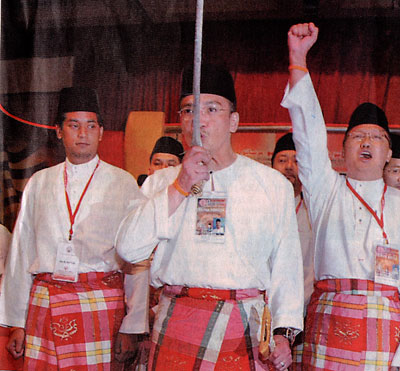
• Perlis delegate Hashim Suboh, who directed his question at Umno Youth chief Datuk Seri Hishammuddin Hussein: “Datuk Hisham has unsheathed his keris, waved his keris, kissed his keris. We want to ask Datuk Hisham when is he going to use it.”

• Razak Idris, Ketua Penerangan Pemuda Umno Terengganu who said that “Hak Orang Melayu tidak boleh dicabar, jika tidak orang Melayu akan mengamok, peristiwa Mei 13 akan berulang yang ianya akan lebih teruk daripada tahun 1969 yang akan menjadikan Kuala Lumpur padang terkukur”.

• Former Minister, former Barisan Nasional and Umno secretary-general Datuk Mohamad Rahmat who warned that the Malays can run amok.

Malaysia's government regularly cautions its constituents that open and honest dialogue of the "sensitive" subject of race is strictly off limits. Writes Ioannis Gatsiounis - Asia Times "The racial divide widens in Malaysia"

Then comes along the week-long United Malays National Organization (UMNO) annual assembly, at which Muslim Malay party leaders warn the country's minority Chinese and Indians that questioning the special status of Islam and Malays in society will be met with violent doom.

Remarks by Hasnoor Hussein, an UMNO delegate from Malacca, were typical: "UMNO is willing to risk lives and bathe in blood to defend the race and religion. Don't play with fire. If the [other races] mess with our rights, we will mess with theirs."


What troubles many Malaysians about UMNO's lack of restraint is that it comes at a time when the country appears more racially polarized than it's been in decades. Malaysia's mix of ethnic Malays, Indians and Chinese has long been resentful of each other and willfully segregate themselves. Those resentments exploded into full-blown race riots in 1969, when ethnic Malays attacked and killed scores of ethnic Chinese.

n the face of a creeping Islamization, non-Malays and social activists have recently pressured Malaysia's UMNO leadership to grant equal rights to all of the country's citizens regardless of race or religion - as is guaranteed under the federal constitution.

In particular, they have also become more vocal in questioning a controversial affirmative action program intended to help Muslim Malays catch up economically with the ethnic Chinese, who comprise 60% and 25% of the population respectively.

Started in 1971, the so-called New Economic Policy (NEP) was originally intended to last 20 years but has since been extended indefinitely. That's because, according to the government, its target of 30% Malay ownership of the country's total corporate equity still has not been achieved. According to official statistics, that percentage now hovers around 18%. Yet a study conducted by an independent academic last month contested that figure by claiming that ethnic Malay total equity ownership could already be as high as 45%.

The push for more democracy in authoritarian Malaysia leaves its ethnic Chinese and Indian minority groups particularly vulnerable - a fact reflected in the racial bashing at this year's UMNO assembly. At the same time, UMNO's preoccupation with racial politics raises growing doubts about its ability to lead the country forward faced with the challenge of China's economic emergence. The party leadership has openly acknowledged the need for Malaysia to change course if it is to remain competitive with its fast-rising neighbors.

Economic growth slowed from 7.2% in 2004 to 5.2% last year, while foreign investment dropped 15% to $3.9 billion. Prime Minister Abdullah Badawi has promoted his concept of Islam Hadhari, or Civilizational Islam, a modernist interpretation of the faith that stresses moderation and technological and economic competitiveness. In that direction, his party has also introduced plans to transform Malaysia into a regional information technology, agricultural and biotech hub.

"We need an economic transformation," Abdullah said in his opening address at the UMNO assembly. Yet tight curbs on personal freedoms, implemented to curb racial tensions, have hindered the open inquiry and innovative spirit necessary to achieve Abdullah's vision. The next phase of economic development will require coincident social transformation, reforms the current race-obsessed political leadership is reluctant to implement.

Oddly, UMNO was once a progressive party, championing what seemed a viable vision to improve equity among the races. Even into the 1990s, under the iron-fisted leadership of Mahathir Mohamad, UMNO looked primed to lead Malaysia toward developed country status. The shimmering steel and glass that spangle Kuala Lumpur's skyline are remnants of that now fading vision.

But the plan went awry as UMNO became politically entrenched in power. Meanwhile, Malaysia's social development and technical know-how has not kept pace with its infrastructural achievements. A common concession in Malaysia, even among its own leadership, is that the country has first world infrastructure but a Third World mentality. Now, that dubious distinction is becoming increasingly obvious to outsiders.

The country's leadership must take much of the blame. UMNO has clung to old solutions, such as the NEP, to fix new problems. Put another way, UMNO, which has ruled Malaysia for four-plus decades through a coalition of other race-based parties, has become bitter, cynical and defensive - a party that is emphasizing preservation at the expense of progress.

Even younger UMNO members, once portrayed as idealistic, urbane and liberal, have quickly come to resemble the party's conservative old guard. And now they often represent the front edge of the party's increasing racist angst. For instance, Abdullah's Oxford-educated son-in-law, Khairy Jamaluddin, who is coincidentally the deputy chief of UMNO's youth wing, warned in September that Chinese political groups would try to take advantage of any split inside UMNO.

When pressured to apologize, according to media reports, the 31-year-old said, "What is there to apologize for? ... I am only defending my race." At the annual assembly, meanwhile, UMNO youth chief Hishammudin Hussein urged the government to reject proposals for an inter-faith commission intended to foster better understanding among Malaysia's various religious groups.

He brandished a Malay dagger, known locally as a keris, when speaking. Some delegates, it seemed, urged him to go further. "Datuk Hisham has unsheathed his keris, waved his keris, kissed his keris. We want to ask Datuk Hisham, when is he going to use it?" said UMNO Perlis delegate Hashim Suboh.

Non-Malays are seeking to exploit the fiery tone of the UMNO assembly to their own political advantage. Liow Tiong Lai, youth chief of the Barisan Nasional component of the Malaysian Chinese Association, said the day that the assembly wrapped up, "All of us are Malaysians in this multiracial country and hatred must not exist. Instead, we must find strength in diversity. We must inculcate love and unity among the races in order to overcome obstacles together."

Malays and UMNO party members will question the sincerity of such remarks, and not without reason. Following UMNO's example, all of Malaysia's major political parties are explicitly race-based, and all have been known to play the race card to shore up their support bases. But only UMNO has the weight of an assembly that has incited anger, mistrust and ridicule of other races.

This year's assembly could mark a dangerous turning point for a country that not long ago was often applauded internationally as a model moderate Islamic nation for its seeming religious tolerance and clear economic achievements. Nowadays, it's altogether unclear if a racially charged UMNO can even manage to maintain short-term social and political stability.


Malaysia 81 on list of flawed democracies

Malaysia is a "flawed democracy" and falls nearly at the bottom of the list, below Mongolia, Sri Lanka, the Philippines, Indonesia, Timor Leste and Palestine in a new Democracy Index developed by the Economist Intelligence Unit.

The index, which is available in The Economist's annual publication The World in 2007, grades 167 countries out of 192 independent states according to their degree of democracy.

The index looks at 60 indicators across the five categories of electoral process and pluralism, civil liberties, the functioning of government, political participation, and political culture.

Countries are spread across four regime types Ð full democracies (28 countries), flawed democracies (54), hybrid regimes (30) and authoritarian regimes (55).

"Sweden leads the pack with a near-perfect score followed closely by Iceland and the Netherlands.

"By contrast, the United States (ranked 17th), Britain (23rd) and France (24th) are near the bottom of the full democracy category," a press statement from The Economist said.

South Africa leads the "flawed democracy" category at 29th position, followed by South Korea at 31, Taiwan 32, India 35, Mongolia 56, Sri Lanka 57, the Philippines 63, Indonesia 65, Timor Leste 65, Bangladesh 75, Hongkong 78 and Palestine 79.

Malaysia ranks 81, sharing the spot with Bolivia at the bottom of the category.

The statement said "flawed democracies" were concentrated in Latin America and eastern Europe.

"Many of these countries remain fragile democracies. Levels of political participation are generally very low and democratic cultures are weak," it said.

Malaysia, however, remains ahead of Singapore (84), Thailand (90) and Cambodia (105) which fall under the "hybrid regimes" category, of which Iraq (112) anchors.

Pakistan (113) tops the list of "authoritarian regimes" while North Korea ranks last. In between are China (138), Vietnam (145), Laos (155) and Myanmar (163).

The Economist said more than half of the world's population lived in a democracy of some sort, although only 13% reside in full democracies.

"Despite the advances in democracy in recent decades, almost 40% of the world's population still live under authoritarian rule," it said.

It added that after decades of progress, the most recent global trends in democratisation have been negative, signalling a pause in the spread of democracy.

Report Here.


Meanwhile, Malaysia signed a deal worth 417 million ringgit (US$114 million; €88.7 million) Wednesday to acquire fighter trainers from Italy's Alenia Aermacchi SPA.

The Royal Malaysian Air Force will use the eight MB-339 jets to train its next generation of pilots to fly advanced aircraft, the Defense Ministry said in a statement.

Malaysia will receive the trainers in stages starting early next year, the statement added.

The acquisition is also expected to help speed up Malaysia's talks with Italian officials to boost landing rights for flights to Rome and Milan, the ministry said.

Defense Minister Najib Razak said earlier this year Malaysia wanted Aermacchi fighter jets to add to 10 similar planes currently used for training purposes to produce better pilots to fly sophisticated Russian-made Sukhoi fighters that the air force will receive soon.


3 Malaysian Palm Oil Entities to Merge.

Three of Malaysia's largest palm oil producers are to merge, Malaysia's Deputy Prime Minister said Thursday, a fusion that could potentially create the world's biggest biofuels company and its largest publicly-traded palm oil entity.

Kumpulan Guthrie Bhd., Sime Darby Bhd. and Golden Hope Plantations Bhd. all halted trading in their shares and listed subsidiaries Thursday, ahead of the announcement that could come as early as Monday, according to industry executives. The companies are under the government fund manager Permodalan Nasional Bhd. umbrella.

"This is a PNB initiative," Najib Razak told reporters Thursday, referring to Permodalan.

"They want to rationalize the companies within the group ... They believe the companies should be consolidated," Najib said. "We (the government) support the move by PNB."

The deal will create the biggest listed palm oil producer in the world in terms of output and market value, analysts said. The new entity could be merged under a new company called Synergy Drive. Malaysia Boleh !!

"The one good reason I can see is that they can benefit from combined hectarages," said Malaysia's Plantation Industries and Commodities Minister Peter Chin said. "They would be able to synergize in their mills and refiners" while reducing cost and improving efficiency, he added

The government has said it would attempt to streamline its enterprises in a bid to cut costs and reduce overlap in businesses. It has also said it would push Malaysia's palm oil producers to develop its biofuels industry, which has attracted attention as countries try to reduce their dependence on fossil fuels.

Malaysia is the world's biggest palm oil producer, and its companies are also big players in neighboring Indonesia, another major producer of the edible oil.

Palm oil and soybean oil are the world's top edible oils, but palm oil is becoming a top ingredient in biofuel as well.

Biofuels development could require companies to revamp, or build new, plants for expanded production, and a merger is likely to save on cost.

A combination of the three companies' palm oil businesses will yield annual revenue of at least $2.02 billion and yearly operating profit of around $248 million.

The three companies also have a total 1.3 million acres of land in Malaysia and Indonesia planted with oil palm, producing more than 2.1 million tons of crude palm oil annually _ equivalent to 13 percent of Malaysia's total output.


Labels:

17 November, 2006

Will it boil down to 'them versus us'?

Is the show of strength and bluster by Umno delegates going to have a lasting impact?

From Monday till yesterday, most of the party delegates who took to the rostrum, made it known publicly that the Malays would no longer tolerate any form of threats.

It was a strong message: Don’t test us or else...(What ??)

Many speakers accused leaders of Barisan Nasional component parties of questioning the Malay rights while almost all blamed the Chinese business community for "taking more than what they needed".

"Our tolerance... made those who dared to challenge the Malays and Islam become bolder as they felt no action would be taken against them."

Most delegates used the term "Malay rights" interchangeably with "Malay dominance" and "social contract".

"Datuk Hisham has unsheathed his keris, waved his keris, kissed his keris. We want to ask Datuk Hisham, when is he going to use it?"

In reference to what he alleged as the Education Ministry’s weakness in dealing with demands from the Chinese language schools, Hashim said force must be used against those who refused to abide by the social contract.

Just a few hours before, Hishammuddin told reporters that harsh criticism against non-Malays by delegates would not affect the cordial relationship among BN members.

"This is normal. They have a job to do, we have a job to do too.

"But the fundamental issue is our intention and objectives."

Yesterday’s debate on the economy, fear of non-Malays, especially the Chinese, taking over the Malay slice of cake dominated the assembly.

Will all this venting of anger invite a negative reaction from those outside the hall?

Will it reinforce stereotypes and prejudices? Will it drive a wedge between Malays and non-Malays?

The answer to the three questions is YES.

Researcher Liew Chin Tong believes the anti-Chinese feelings are building up among Umno members although Abdullah is trying very hard to tone down the situation, with his reform agenda.

"It is as if we are going back to the 1980s," he said.

"The former premier managed to make Singapore and the US our enemies. Now we are back to distrusting each other."

Liew believes the "them versus us" rhetoric could lead to further polarisation.

"People who were vilified will feel offended. But I don’t think we’re violent.

"Most probably people will express their views during elections.

"For outsiders, they might not want to invest in Malaysia, believing something is wrong here while some Malaysians may leave the country," he added.

Political analyst Amir Sari believes that Umno delegates’ anger towards non-Malays could help obscure Chinese organisations gain some prominence and push some Chinese chauvinists to the fore.(NST-Wan Hamidi Hamid)

Author of Asli research also comes under fire At the Umno General Assembly. DELEGATE after delegate took to the stage and spoke against any move to question the social contract.

Many of them trained their guns on the Asian Strategic Leadership Institute — the think-tank behind the controversial study on Bumiputera equity ownership.

Several Umno representatives targeted Dr Lim Teck Ghee, the author of the report which suggested that Bumiputera corporate equity had reached 45 per cent.

But outside the hall, Foreign Minister Datuk Seri Syed Hamid Albar attempted to inject some moderation into the strong language employed by some Umno delegates.

For a start, he said that their views did not necessarily reflect the government’s position.

"Let us not rekindle very sensitive issues that can create dissension among Malaysians of different communities here. We cannot afford that."


Nothing new in Abdullah's speech - Mukhriz

The son of former Prime Minister, Dato' Mukhriz Mahathir said he was a 'little bit' disappointed with the Umno presidential speech at its AGM yesterday, claiming it offered nothing new.

"I think it's an address he delivered last year. I was hoping for something new. Perhaps, he has other ideas.

"We were hoping that there would be some kind of attempt for reconciliation, some attempt to specifically answer the questions,”"he said, when met by reporters.

On whether his views were being shaped by that of his father, Tun Dr Mahathir Mohamad, Mukhriz said: "I guess I am not just obliged to support my father. I believe 100 percent what he (Dr Mahathir) says and the way he feels about things."

Mukhriz said they wanted answers so that they could move on and support every decision the Abdullah-led Government made.

"We are open to be convinced. We are waiting for answers. We are waiting for good explanations why things are. But until now – it's been six to eight months – we are still waiting."

Mukhriz said the mere mention of his mother's (Tun Dr Siti Hasmah Mohd Ali's) name got a huge round of applause from the floor.

"Imagine if my father had attended this meeting or if his name was mentioned. We don’t know how the delegates would react.

"So, maybe that's the reason why his name was kept out in most part of the (Abdullah's) speech.

On the gesture made by the Prime Minister asking delegates to pray for the good health of Dr Mahathir, Mukhriz said this was appropriate and sincere.

Dato' Paduka Marina Mahathir when contacted after the opening said that there was less semangat (enthusiasm) compared to previous assemblies.

"For me, there was a lot more rah-rah previously," she said, adding that she attended the opening to accompany her mother.(umno - reform)

Leaders hit out at Mukhriz.

Youth chief Datuk Seri Hishammuddin Tun Hussein said Mukhriz's remark was extreme and an embarrassment for the movement.

He said it was sad that Mukhriz had made such a remark when he was a senior executive council member of the movement, adding that it was his (Mukhriz's) personal stand and sentiment.

“On behalf of Umno Youth, I would like to state that Mukhriz's remark is not reflective of Umno Youth's stand and view. We have expressed our undivided support for the president and Umno Youth has recognised the contributions made by Tun (Dr Mahathir Mohamad, former Umno president and former prime minister),” he told reporters after attending the dinner hosted by Umno Deputy President Datuk Seri Najib Tun Razak for delegates to the Umno general assembly.

Hishammuddin said he would have to reconsider the position of Mukhriz in the Umno Youth executive council line-up if more such remarks came from him.

Umno Putera chief Datuk Abdul Azeez Abdul Rahim accused Mukhriz of being the source of the rift between the Prime Minister and Tun Dr Mahathir Mohamad.

“He clapped his hands when he was listening to Pak Lah’s speech but gave a twisted statement when he came out.”

Supreme Council member Datuk Ahmad Zahid Hamidi said Mukhriz had insulted the party president, adding that his remark smacked of hatred for Abdullah.

“Because Mukhriz is thick with prejudice, the hatred has closed his heart and mind so much that he could not see the depth in Pak Lah’s speech.”

Datuk Azalina Othman Said, also a Supreme Council member, said she was taken aback with the criticism, adding that it did not help with efforts to mend the rift between Abdullah and Dr Mahathir.

She said Mukhriz should have known better and been more respectful towards the party leadership.

Datuk Seri Zainuddin Maidin said that there was new material in Abdullah’s speech, especially on the distribution of wealth among Malays.

“It depends on where you stand. There are two sides to a coin. Maybe, that is why Mukhriz cannot see anything new.

“He (Abdullah) has a different style and approach in running the Government.”

Another Supreme Council member, Datuk Mohd Zin Mohamed, said he was disappointed that such an important speech had been trivialised by Mukhriz's comment.


UMNO stirs passions on ethnic rights

Malaysia's ruling party is claiming that ethnic Chinese earn nearly double what Malays make and own two-thirds of the country's commercial sites even though Malays are in a majority.

Malaysia's ruling party, the United Malays National Organization, is blending these statistics with potent rhetoric at its annual congress this week to assert what many Malays consider their birthright - affirmative action meant to lift them out of poverty.

"We will not budge an inch in defending our rights," said Mohamad Zan Abu, an UMNO official from the southern state of Johor, in a speech Tuesday. "We will defend these rights to the last drop of our blood."

Such talk is sure to cause unease among minority ethnic Chinese, who form 25 percent of the population, and Indians, who account for 10 percent. It will also fuel complaints that Malays, who comprise 60 percent of Malaysia's 26 million people, are pampered.

But there is a greater fear that dissatisfaction with the affirmative action policy could erupt into racial tensions.

Since UMNO's 1946 inception, it has represented the interests of ethnic Malays, who are Muslims. The party dominates the multi-ethnic National Front coalition government.

Political analyst Denison Jayasooria said no one disputes Malays' right to govern because of their majority, but it is only fair that "all marginalized sections should be reached irrespective of race."

He added: "The language that's being used now is making us further apart, creating new insecurities to a younger generation where ethnicities and nationalities are in conflict. We should first see ourselves as Malaysians."

More than four centuries of European colonization left most Malays impoverished farmers and rubber plantation workers at independence in 1957. Ethnic Chinese, who first migrated to Malaysia in the 19th century, prospered through trade and tin mining.

According to government statistics, for every 1 ringgit (HK$2.14) a Malay citizen earns in Malaysia an ethnic Chinese earns 1.64 ringgit.

According to the statistics, Malays own 11.7 percent of commercial sites, while ethnic Chinese own 71 percent.

Affirmative action policies were instituted after race riots, sparked by Malay dissatisfaction toward ethnic Chinese economic clout, killed hundreds in 1969. The privileges for Malays in areas such as government jobs, housing, bank loans and contracts aim to help them achieve a 30 percent corporate equity target by 2020.

UMNO's agenda has also extended to insisting on Islam as the predominant religion. Non-Muslims complain they cannot seek recourse in disputes involving religious matters with Muslims because the secular courts have no jurisdiction over the Islamic legal system.

That is not going to change, said UMNO's youth chief, Hishamuddin Hussein. "Any movement in the name of freedom of religion, freedom of speech or freedom of the media will not be allowed to challenge our rights," Hishamuddin said Tuesday.

"If such negative efforts are not curbed, they will have a huge implication on our harmony," he said. (The Standard)


Malaysia's leader warns of religious and ethnic tensions

Malaysia's prime minister, Abdullah Ahmad Badawi, said Wednesday that frayed relations between the country's religious and racial groups had reached a "worrying" level and warned that the government would not hesitate to crack down to preserve peace between them.

"Freedom has its limits," Abdullah said in a nationally televised speech to his party that serves as an annual state of the union address for the country. "I would like to warn those who abuse this freedom that I will not for a moment hesitate to use the law against them."

Abdullah's threats were a marked shift in tone for a prime minister who previously portrayed himself as more conciliatory and compassionate than his predecessor, Mahathir bin Mohamad.

At a time of both political and ethnic tensions, a number of recent incidents and court cases have soured relations between Malay Muslims and the rest of the country's 25 million population: Christians, Hindus, Buddhists, Sikhs and others....(more)
(International Herald Tribune)


An excerpt from Zainon Ahmad of UMNO Reform :"Umno delegates stick to the script"

Youth spotlight on 'questioning' of Malay rights

They came fast and furious, their delivery invariably laced with pantun and sometimes rib-tickling racy jokes.

For the 13 delegates picked to debate on issues of the day at Umno Youth's general assembly yesterday, the subject of their rhetorics expectedly reflected newspaper headliners - and the concerns of the grassroots nationwide.

Against the general debate on the Malay Agenda, a traditional favourite in any general assembly, delegates dwelt specifically on the perceived trend to question the rights and privileges of the Malays and the position of Islam.

The full force of the Youth movement was brought to bear on these issues, with punchy messages designed to influence national policies.

This is what the delegates said on the following topics:

Economy and the Malay Agenda:

Youth information chief Datuk Azimi Daim, in tabling the resolutions, set the tone with his call for the Malay Agenda to be made one of the main thrusts of the Ninth Malaysia Plan which was launched in March this year.

"The income disparity is not only between urban and rural Malays but also within regions of the country which show an obvious imbalance in terms of economic development.

Because of this, existing development projects have not brought about equal wealth distribution. I call on the government to renew commitment to attain the 30% bumiputra equity ownership target, and more importantly to come up with more effective strategies to ensure this is done.

"We should also look at why questions on the rights and privileges of the bumiputras are being raised by certain quarters now, even those from the BN family, when these are enshrined in the Federal Constitution.

"Umno Youth must be more effective, creative and proactive in defending such ights and privileges, as these are issues that make members jump.

"When certain issues come up, it is natural for the warrior blood in the veins of the Malays to become heated."

Razali Idris (Terengganu): There is no way for Umno to remain strong if the economy is weak. The Malay's economic growth is only about 2%, while the non-bumiputra's is at 6%.
"This wide disparity will create unrest and an incident like May 13 might repeat but this time, the parang will not fly." The special privileges enjoyed by the Malays should not be challenged. "An ants' nest should not be disturbed".

Mohd Zan Abu (Johor): "The National Economic Policy and subsequent policies were not effective in uplifting the Malay community.
"In this regard, the Malay Agenda should be strenghtened to be more effective.

"Whether it (the bumiputra equity ownership) is 18% or 40% is not the question. The fact is the Malays are still lagging behind."

Religion:

Mohd Effendi Yusof (Kelantan): "Those who spread rumours and sms that there are about 250,000 Muslims in the country who had apostacised should be detained under the Internal Security Act or the Sedition Act.
The recent sms incident in Ipoh created an uproar among the Malays and the Internal Security Ministry should use its powers to act against those who created this unrest among the Muslims here." On Article 11, he said if such groups and others including the opposition are allowed to do what they are doing, there will be rampant cases of apostacy. "The most surprising part is that many of our own Muslims support such groups. If we were to follow Islamic Law, such people should be killed, but we don't do such things here." He questioned what Jakim and the ulamas are doing about such allegations.

"Don't play with fire...we (muslims) will fight till the end."

Social Ills:

Mohd Zan Abu: "The rampant cases of drug addiction, lepak, bohsia and Mat Rempit, sees the need for more effective measures to be taken. Umno Putra should be praised for taking the initiative in coming up with programmes on Mat Rempit."
Mohd Effendi Yusof: "What happened to all the government agencies and institutions when there was a problem with Mat Rempit? Please help safe the Mat Rempit's...they are actually an asset to the nation."
Education:

Mohd Zan Abu: "The meritrocracy issue should be re-examined. We do not want future generation to blame us for not doing anything, when it mattered."
Muhamad Nor Dawoo (Perak): "The shortcomings in the teaching of Maths and Science in English should be rectified to prevent our children from falling through. Teachers who lack the necessary skills in teaching Science and Maths in English should be sent abroad for the necessary courses. To improve the education system, the examination marking system should be re-evaluated."

Hishammuddin raises the Panca Warisan, the keris that symbolises Umno's Youth's struggle, at the start of the assembly.

On those who create disunity:

"Don't wager the future of the nation in the hands of those who are bankrupt of ideas on politics of unity and harmony. We remind them against stoking the fires of disunity. We know who they are, we know where they are and what they are saying. We will ensure they have no place as leaders in the Barisan Nasional struggle."

On the Panca Warisan, the keris that symbolises Umno Youth's struggle, which he raised for the first time last year and again this year:

"I remember that in last year's assembly, the Panca Warisan triggered concern among non-Malays. So narrow is their thinking and understanding of the cultural heritage of our forefathers. Aren't they aware that all along, we have together upheld the concept of Unity in Diversity? The keris should not be regarded as a symbol of oppression of the non-Malays by the Malays."

On Tun Dr Mahathir Mohamad and the prime minister:

"We give undivided support to the president who leads us; and respect and love to past leaders. To Tun Dr Mahathir Mohamad, we owe a debt of gratitude. To Datuk Seri Abdullah Ahmad Badawi, (we say) continue to lead us."

On race and religion:

"Of late, certain quarters seem to be taking advantage (of the new climate of openness) to test the government's level of tolerance. Issues on race and religion are debated without considering rationally the effects on race relations. Criticisms, which should be constructive, are increasingly vindictive, meant to release frustrations and hatred and made with bad intentions and jealousy.

"Some are spreading falsehood and rumours and are instigating. Such developments hurt the feelings of the Malays and Islam. Don't toy with, question or challenge the position of the Malays and Islam in this country.

"Any action, whether in the name of religious freedom, freedom of expression or freedom of the media, will not be allowed to challenge the rights and position as enshrined in the Federal Constitution.

"To those who call themselves Article 11, Umno Youth warns Ð don't try to raise issues regarding Article 11 and Article 121(A). Umno Youth is of the opinion that any questions and issues on Islam should be heard and judged by the Syariah Court, and not Civil Court, in line with Article 121 (1A). On the suggestion to form the Inter-faith Commission, Umno Youth urges the government to reject it outright."

On the Malay Agenda:

"The Malay Agenda in the National Mission should not be regarded as a zero-sum game, by saying only the Malays are benefiting and that the non-Malays are losing out. The non-bumiputras should be brave enough to admit that during the implementation of the New Economic Policy, they also derived benefits, either directly or indirectly, through projects in the various sectors."

On income parity:

"Although the bumiputras form the majority in this country, the income parity between bumiputras and non-bumiputras is still worrying. In fact, it is widening. For example, the income disparity between bumiputras and ethnic Chinese in 2004 is 1:1.64. Is it wrong if the government makes an effort to reduce this to 1:1.5 by 2010? Believe me, if nothing is done to address this situation, it will take 120 years to achieve income parity with the non-bumiputras, as mentioned by a group of researchers from Universiti Putra Malaysia.

On the NEP:

"Umno Youth reminds those who harp on the racial equity ownership issue to desist. If we don't want to talk about the concentration of wealth distribution in one particular race, then they should look into discriminatory practices in the marketplace, in particular the practice by some non-bumiputra companies which makes it a condition that one must know a certain language to get a job."


***************

Text rumour tests religious ties
By Claudia Theophilus

A widely circulated text message is being blamed for stoking religious tensions in Malaysia.

The SMS sent this month led to hundreds of Muslim protesters gathering outside a Roman Catholic church in the northern town of Ipoh to try to stop a rumoured conversion of 600 Muslim students to Christianity.

The incident on November 5 outside the Our Lady of Lourdes church is being investigated under Malaysia's sedition act.

Police have said they intend to question Harussani Zakaria, the mufti of the northern state of Perak, and Azhar Mansor, a locally famous sailor, who were both named in the message.

Officials said they were trying to find out whether the allegations - that Azhar would be leading 600 Muslim students through baptism - originated from a talk Harussani gave at a mosque programme this month.

Neither man could be contacted. However, Harussani has since identified a woman in her 40s as the source of the SMS, which he said he sent to representatives of Muslim groups out of concern.

But, speaking to reporters this week, he said he had cautioned against any protest without evidence.

Verbal threats

Bernard Paul, a parish priest in Ipoh, said that about 100 children were in his church when he saw between 200 and 300 protesters approaching.

"We heard chanting of anti-apostasy slogans," he said. "Police were trying to seal off the roads around the church but that attracted more curious onlookers. The protesters ignored warnings to disperse until about noon.

"Senior officers assured us that everything was under control but the crowd kept swelling. There were verbal threats of burning down the church and someone threw firecrackers into the compound.

"That night, a motorcycle gang rode past the church chanting and hurling rocks. A lady was hit on the thigh and later lodged a police report. We made similar report earlier over the disruption of a religious service."

Paul said that police had asked him about conversion procedures and the presence of Malays in the church about three weeks ago.

"But if police already knew about the allegations, why didn't they do anything to verify the facts? They could have informed the church and we could have easily cleared the air in a statement to diffuse the tension," he said.

Recent years have seen a series of anti-apostasy protests by Muslim groups claiming that Islam is being undermined by liberal Muslims and Malaysians who demand that their right to religious freedom under the constitution be upheld.

Just over 60 per cent of Malaysia’s population of 27 million are ethnic Malay-Muslims.

According to the Malaysian constitution a Malay is defined, among others things, as being a Muslim.

Hermen Shastri, the general-secretary of the Council of Churches, Malaysia, described the reaction to the SMS rumour as "very worrying".

"There definitely needs to be a defined policy on SMS messages," he said. "This is not the first time such a message has been circulated."

He said he had frequently received circulated SMS relating to the case of Lina Joy, a Malay woman who is trying to remove the word Islam from her national identity card.

The landmark case is currently awaiting a decision from the country’s highest court.

‘Intimidation tactic’

Hermen blamed "people with malicious and ill-intent" for circulating the SMS and trying to agitate more Muslims into taking to the streets stoke inter-religious tensions.

"The government has to come up with rules," he said.

"If there are any grievances, people should lodge a police report. This is an intimidation tactic to instill fear. The rule should be that no one should go to places of worship of other faiths and interfere in their worship."

Musa Mohd Nordin, founding member of the Muslim Professionals Forum – a body which aims to increase understanding of Islam in the English-speaking world - condemned the reaction.

"No ethnic or racial group should be acting on hearsay," he said. "If the group of Muslims had congregated at the church based on an SMS and not evidence, I think that is very unfortunate and unbecoming for a Muslim group.

"A particularly inflammatory issue like this must be based on clear evidence. Even if the allegations were true, it was uncalled for them to demonstrate. A negotiation or meeting with the church would have been a better way to handle the situation."

He also warned liberal Muslims against linking Sunday’s "isolated" incident with other anti-apostasy protests and said it was dangerous to use words such as "hate ideology".

'Despicable act'

Zaitun Kasim of women’s rights group Sisters In Islam apologised for what she said was the "fear and anxiety" caused by the "actions of a small, ill-informed group of Muslims".

"The despicable act of writing and forwarding the SMS itself was designed to sow hatred and ill-will," she said.

"Islam, as with other religions, does not in any way condone any form of violence."

She said she was "gravely disappointed that the actions of some Muslims have not only brought the religion into disrepute but have caused harm to other Malaysians".

Citing a recent spate of incidents, Zaitun said that the Ipoh case pointed to "a regressive and damaging trend where individuals and groups have deliberately used religion to drive a wedge between the different ethnic groups".
(Source: Al Jazeera)


Labels: